Showing posts with label Arab Uprisings. Show all posts

Thursday, September 22, 2011

Act One of the CIA's "Arab Spring": Lebanon's Cedar Revolution: On the Road to Damascus (2005)


Faking the Case Against Syria
By Trish Schuh
Originally published in Counterpunch
November 19-20, 2005
Images and captions added by Color Revolutions and Geopolitics


Another slam dunk forgery is being used to convict Syria. The United Nations’ Detlev Mehlis inquiry into the murder of Lebanon’s former Prime Minister Rafiq Hairri depends on a central witness, Zuhir Ibn Mohamed Said Saddik, who has faced accusations of being a swindler and embezzler. Der Spiegel exposed Saddik’s brags of "becoming a millionaire" from his testimony to the Mehlis Commission. Saddik was referred to the Mehlis Commission by Syrian regime critic Rifaat Assad, the uncle of current Syrian President Bashar Assad. Rifaat has been lobbying the Bush administration to become the president of Syria in the event his nephew Bashar is ousted.

The record of the UN’s investigator Mehlis does not inspire faith in his credibility. As Senior Public Prosecutor in the German Attorney General’s office, Mehlis investigated the 1986 LaBelle Discotheque bombing in Berlin. Relying on alleged National Security Agency intercepts of coded messages between Tripoli and Libyan suspects in Germany (later revealed by former Mossad agent Victor Ostrovsky as false telex signals generated by Mossad itself), Mehlis provided the ‘irrefutable proof’ of Libya’s guilt that then justified Ronald Reagan’s bombing of Libya.

UN investigative chief into the murder of Rafiq Hariri, Detlev Mehlis, makes a public presentation of his politically-charged findings, implicating the government of Syria, a verdict which also corresponds to US/Israeli designs in the region.  Not surprisingly, the Mehlis Commission has been accused by numerous analysts and investigators as having played the role of a cover-up commission.  This link provides one example of the charges being levied against it.
In the case of the accusations against Syria, Mehlis’s case revolves around a series of questionable phone conversations and intersecting calling card numbers allegedly dialled by the perpetrators. It contains no definitive forensics on the car bomb explosives used. Outside investigators have said it could have been RDX plastique, not TNT as Mehlis suggested in his report. The German Mercedes manufacturers were also perplexed at how Hariri’s vehicle, reinforced by the heaviest steel-titanium alloy, was "melted by the force of the explosion," after-effects usually associated with high density DU munitions. The car bomb vehicle (stolen in Japan and never fully traced) was possibly driven by a suicide bomber, whose identity is still unknown. Mehlis’s report then states: "Another only slightly less likely possibility is that of a remotely controlled device."


Images from the Harari assassination in Beirut, Lebanon, February 14, 2005.
Mehlis conclusions on the case , due on December 15 could justify an attack on Syria, using the Hariri assassination as justification. But from Beirut to Damascus, the "Arab Spring" was a neocon forgery designed to destabilize the Levant and redraw the map of the middle east.

Near the Mohammad Al Amin Mosque of former Prime Minister Rafiq Hariri in Beirut, I interviewed a founder of the Martyrs’ Square tent city and asked about US-Israeli sponsorship of the ‘Independence Intifadah’. Surrounded by red and white Lebanese flags, soldier Michael Sweiden of the Lebanese Forces emphasized he was Christian Lebanese.

"We love Israel", he told me. "Israel helps us. Israel is like our mother."

Years before its role in the so-called "Cedar Revolution" (a moniker coined by US Undersecretary of State Paula Dobriansky, a signatory to the Project for a New American Century), Israel awarded citizenship and grants of up to $10,000 to South Lebanon Army soldiers who collaborated with the Israeli Defense Forces during Lebanon’s civil war. The Israeli newspaper Haaretz revealed, "Senior officials at Prime Minister Ariel Sharon’s office were in touch with Lebanese leaders even before the current crisis." Backed by American and Israeli neocons, a Christian Lebanese Likud is proxying Israel’s second invasion.

Nagi Najjar and fellow peacenik
One example is the Lebanese Foundation for Peace, a self-styled "Government of Lebanon in Exile in Jerusalem" founded by former Lebanese Forces’ military intelligence officer Nagi Najjar. Najjar, a CIA consultant, testified not so long ago in support of Ariel Sharon’s "complete innocence" in the Sabra and Shatila affair against charges by Human Rights Watch and regional governments. Najjar has also paired with Mossad agent Yossef Bodansky while lobbying the U.S. congress to intervene in Hezbollah-dominated south Lebanon. His NGO, The Lebanese Foundation for Peace, endorsed the AIPAC-sponsored sanctions against Syria, known as the Syria Accountability / Lebanese Sovereignty Restoration Act of 2003. On his LFP website featuring an Israeli flag, Najjar’s "government in exile" issued an official declaration; "We, the people of Free Lebanon, thank Prime Minister Ariel Sharon and Foreign Minister Silvan Shalom for the campaign launched by the Israeli Ministry of Foreign Afffairs aimed at ousting Syria from occupying Lebanon."

USCFL logo
Another NGO of the Lebanese Likud is the United States Committee for a Free Lebanon. Its President, Ziad Abdel Nour is the son of wealthy Lebanese Minister of Parliament Khalil Abdel Nour. USCFL partners with designated "democratizers" such as the American Enterprise Institute (created by Lebanese-American William Baroody, Sr.), Conference of Presidents of Major American Jewish Organizations, Jewish Institute for National Security Affairs, Republican Jewish Coalition, Foundation for the Defense of Democracies, Middle East Forum, the Hudson Institute and kindred pro-Israel lobbies.

The USCFL hails former Lebanese president Amin Gemayel for signing a peace deal with Israel in 1983. (According to the UAE’s late president Sheik Zayed bin sultan Al Nahyan, Saddam Hussein agreed to leave Iraq before the war in 2003 to halt the invasion. But Amin Gemayel, the mediator between Saddam and the US administration, wrongly informed the US that Hussein had rejected all offers of exile). Abdel Nour’s other links include the World Lebanese Organization, which advocates Israel’s re-occupation of south Lebanon. In 2000, he and neocon Daniel Pipes composed the policy paper "Ending Syria’s Occupation of Lebanon: the US Role" and together co-author the Middle East Intelligence Bulletin. The bulletin is a project of the neocon Middle East Forum and is a frequent resource for American intelligence agencies. On November 2, 2005 Abdel Nour updated me on the Syrian crisis by phone.

Schuh: What is the future of Syria, of President Bashar Al Assad’s situation?

Ziad Abdel Nour, Committee for a Free Lebanon
Nour: Both the Syrian and Lebanese regimes will be changed- whether they like it or not- whether it’s going to be a military coup or something else… and we are working on it. We know already exactly who’s going to be the replacements. We’re working on it with the Bush administration. This is a Nazi regime of 30 years, killing ministers, presidents and stuff like that. They must be removed. These guys who came to power, who rule by power, can only be removed by power. This is Machiavelli’s power game. That’s how it is. This is how geopolitics — the war games, power games — work. I know inside out how it works, because I come from a family of politicians for the last 60 years. Look, I have access to the top classified information from the CIA from all over the world. They call me, I advise them. I know exactly what’s going on. And this will happen.


Q: So would they remove the entire Assad family?


A: Why not? Who is Bashar Al Assad?


Q: I didn’t see forensic proof in the Mehlis report that would legally convict Assad of Hariri’s death in a court of law.


A: I don’t give a damn. I don’t give a damn, frankly. This Bashar Al Assad-Emil Lahoud regime is going to go whether it’s true or not. When we went to Iraq whether there were weapons of mass destruction or not, the key is — we won. And Saddam is out! Whatever we want, will happen. Iran? We will not let Iran become a nuclear power. We’ll find a way, we’ll find an excuse- to get rid of Iran. And I don’t care what the excuse is. There is no room for rogue states in the world. Whether we lie about it, or invent something, or we don’t… I don’t care. The end justifies the means. What’s right? Might is right, might is right. That’s it. Might is right.


Q: You sound just like Saddam. Those were his rules too.


A: So Saddam wanted to prove to the whole world he was strong? Well, we’re stronger- he’s out! He’s finished. And Iran’s going to be finished and every single Arab regime that’s like this will be finished. Because there is no room for us capitalists and multinationalists in the world to operate with regimes like this. Its all about money. And power. And wealth… and democracy has to be spread around the world. Those who want to espouse globalization are going to make a lot of money, be happy, their families will be happy. And those who aren’t going to play this game are going to be crushed, whether they like it or not! This is how we rule. And this is how it’s going to be as long as you have people who think like me.


Q: When will this regime change take place?


A: Within 6 months, in both Lebanon and Syria.


Q: Some names of replacements?


A: It is classified. There are going to be replacements and we know who they are, but I cannot mention the names.


Q: Will this be done peacefully?


A: It doesn’t matter. The end justifies the means. I don’t care about how it’s done. The important thing is that it is done. I don’t rule out force. I’m not against force. If it’s an option, it will be an option.


Q: But if it’s just trading Syrian control for American or Israeli control?


A: I have — we have — absolutely no problem with heavy US involvement in Lebanon. On an economic level, military level, political level, security level… whatever it is. Israel is the 51st state of the United States. Let Lebanon be the 52nd state. And if the Arabs don’t like it, tough luck.


Formalized by the newly-created League of Nations, the French Mandate of Syria and Lebanon was established after WW1, which then granted France control over a huge chunk of the defeated Ottoman Empire.  Both Syria and Lebanon gained independence in 1943.
President Camille Chamoun
US-Israeli intervention in Lebanon has a long history. In 1950′s Beirut, The U.S. oil companies and the CIA paid bribes to Maronite Catholic President Camille Chamoun to buy allegiance against Lebanese Muslims, and the pan-Arab threat of Nasser. In his book Ropes of Sand, CIA case officer William Crane Eveland revealed, "Throughout the elections, I traveled regularly to the presidential palace with a briefcase full of Lebanese pounds, then returned late at night to the embassy with an empty twin case" to be refilled again with more CIA funds. Journalist Said Aburish recalled, "The convergence of interest between the Camille Chamoun government and CIA agents produced a bizarre atmosphere which altered Beirut’s character. It became a CIA city…" frequented by such covert operatives as Kermit Roosevelt (who organized the Iranian coup against Mohammed Mossadeq). Soon the Israelis joined in, supplying weapons to Chamoun’s son Dany, an arms trader. Dany’s weapons sales to Maronite gangs created a precedent for the country’s civil war militias. ( See Aburish’s A Brutal Friendship: The West and the Arab Elite, 1997)

Michel Aoun
A more recent US-Israeli role commenced in mid-November, 2004. A demonstration was called by former Christian General Michel Aoun. (Aoun testified to the US Congress in 2003, and Congress favors him as a post-Assad Lebanese president). US diplomats coached a vanguard of unwitting Lebanese youth in CIA "Triple U" techniques (uncontrollable urban unrest). Opposition sources revealed that a downtown rally of 3000 mostly Christian student activists protesting "Syrians Out!" had been organized by the US Embassy in Beirut. The Associated Press reported on November 19, 2004, "One demonstrator appealed to the US president, holding a placard that read: ‘Bush help us save Lebanon.’ Another dressed up as Osama bin Laden but with the words "Syrian Terror" on his chest. He held a toy gun to the head of a protester who was wrapped in the Lebanese flag…"

Rehearsal for the so-called Cedar Revolution began November 19th, 2004.
Lebanese riot police allowed this unprecedented pre-Cedar rehearsal without arrests because of a deal worked out beforehand with US Ambassador Jeffrey Feltman. Feltman, closely linked to Ariel Sharon and Karl Rove, is an associate of the Pentagon’s Office of Special Plans that created the false evidence and "mushroom cloud" intelligence used to justify attacks on Iraq. This 2004 rehearsal demonstration was answered by a counter protest of 300,000 on November 30 against UN Resolution 1559.

Former US Ambassador to Lebanon, Jeffrey Feltman, has since been promoted to the post of the United States Special Envoy to the Transitional National Council of Libya, the NATO-installed puppet regime.
When the stage show opened for real after Rafiq Hariri’s death, America’s Wag the Flag performance was camera-ready. Janes.com exposed that the flashy demonstrations and rallies were being engineered by one of Lebanon’s top advertising agencies and the London-based Saatchi & Saatchi. Michael Nakfour of the corporate events management company, Independence 05 – Civil Society, helped manage the Freedom Square tent city by distributing food, flags, supplies and theatrical effects, prompting American Enterprise Institute scholar Hedieh Mirahmadi to marvel; "Who would imagine one could find posters, in downtown Beirut, with the picture of President Bush in between American and Lebanese flags?" (NY Sun, 3/18/05)

Reporter Mary Wakefield, of The Spectator was also surprised. "Only 1,000 or so people? ..it felt less like a national protest than a pop concert. Bouncers in black bomber jackets wore laminated Independence ’05 cards round their necks, screens to the left and right of the platform reflected the crowd… To the left of the main speaker, a man in a black flying suit with blonde highlights, mirrored Oakley sunglasses and an earpiece seemed to be conducting the crowd. Sometimes he’d wave his arms to increase the shouting, sometimes, with a gesture he’d silence them… ‘Out Syria! Out Syria! Out Syria!’ Production assistants with clipboards busied themselves around trucks full of monitors and amplifiers…. The truth is that the Cedar Revolution has been presented and planned in just the same way as Ukraine’s Orange revolution and, before it, the Rose revolution in Georgia. But just because it is in American interests doesn’t mean it’s an American production." ("A Revolution Made for TV" 3/12/05)

Why not? The New York Post: "US intelligence sources told The Post that the CIA and European intelligence services are quietly giving money and logistical support to organizers of the anti-Syrian protests to ramp up pressure on Syrian President Bashar Al Assad to completely quit Lebanon. Sources said the secret program is similar to previous support of pro-democracy movements in Georgia and Ukraine, which also led to peaceful demonstrations." (3/8/05).

On the streets of Beirut, one ‘grassroots’ project, "Pulse of Freedom," inadvertently exposed its U.S. origins by utilizing uniquely American street theater tactics. Then in a slip, reminiscent of Baghdad’s Firdos Square when US troops covered Saddam’s statue with the Stars and Stripes, or when the Republic of Georgia’s military band played the US national anthem instead of its own during the Rose Revolution, "Pulse of Freedom" portrayed Lebanon’s national Monument of Sovereignty as the Statue of Liberty.

Spirit of America, the NGO that created "Pulse of Freedom" provided protesters with a billboard-sized electronic ‘Freedom Clock’ for ‘Freedom Square’ to "countdown to freedom." Spirit of America’s tax deductible donations helped maintain the tent city’s food, shelter and other basic necessities "so that the demonstrators can keep pressure on for political change and world attention on the struggle for Lebanese independence". Spirit of America also spawned a plethora of revolution bloggers, foremost among them Tech Central Station columnist Michael Totten whose boss was Spirit of America’s founder Jim Hake.


As illustrated by the images above, Lebanon's so-called Cedar Revolution was an expensive, highly-professional production.
A registered charity, Spirit of America exemplifies the regime change industry. Advised by US Ambassador Mark Palmer, Vice Chairman of the Board of Freedom House, and co-founder of the National Endowment for Democracy, Palmer served as speech-writer to three US Presidents and six Secretaries of State. He also helped the US government destabilize Slobodan Milosevic and Muammar Qaddafi. Capitalizing on his color revolution skills, Palmer wrote "Breaking the Real Axis of Evil: How to Oust the World’s Last Dictators Without Firing a Shot."

One of the American experts behind the Cedar Revolution regime change psy-op is Mr. Bow Tie (above), Mark Palmer, co-founder of the National Endowment for Democracy.  Although he's normally kept far away from the publicity lights, Palmer is an apt symbol of the reality behind American-style Democracy Promotion: the kind of man that most mothers would keep their kids away from.
"Revolutionary" Mike DeLong
Another Spirit of America governor is Lt General Mike DeLong, Deputy Commander, US Central Command, MacDill Air Force Base, Florida. DeLong manages a budget of $8.2 billion and "conceived and implemented the Global War on Terrorism, Operation Enduring Freedom and Operation Iraqi Freedom." As top Deputy to former General Tommy Franks, DeLong’s listed expertise at places such as the Army War College, the Department of Defense and the Amphibious Warfare School included Artillery, military intelligence, coup détats, supporting democracy. DeLong in his autobiography Inside Centcom alleged "Syria had been shipping military supplies, including night vision goggles to Iraq." The New York Times and Washington Post later revealed that these data had been fabricated "smoking gun" evidence. Charles Duelfer of the UN Iraq Survey Group also confirmed that WMD charges had been "exaggerated" by now-US Ambassador to the UN, John Bolton, when he was Under-Secretary for Arms Control in 2002.

Lebanese history professor Habib Malik, affiliated with the Middle East Forum, defended the anti-Syria protesters to journalist-in-residence Claudia Rosett of the Foundation for the Defense of Democracies as being "utterly spontaneous and coercion-free." (NY Sun, 3/11/05)

But an American Hezbollah expert in Beirut, Dr. Judith Harik, informed this writer that the pro-Syria crowds were misrepresented in the media. "As you are hearing, the Bush administration is labeling the opposition "the people" and everyone else as Hezbollah terrorists. Tomorrow’s [March 8, 2005] demonstration will include Sunnis, Druze of the Arslan faction, Christians of all the leftist nationalist parties and the entire south and Bekaa, along with Orthodox Christian areas of Mt. Lebanon. Again the Bush administration is misleading the public by ‘mistakenly’ lauding a loud minority that supports its middle east policy."

Each side eventually held a mass demonstration numbered in the hundreds of thousands, prompting a truce. But the US-Israeli machine declared war. Using language formerly reserved for Yasser Arafat, Bush parroted Ariel Sharon. "Syria is an obstacle to peace" and an "obstacle to change". Rep. Sam Johnson (R-Texas) advised, "Syria — put two nukes on ‘em"; Jerusalem Post: "Israel hails Bush’s Islamist attacks"; Jewish Forward; "US promises Israel to tackle Hezbollah."

A deck of ‘Most Wanted’ playing cards appeared, a technique used by the Israeli newspaper Maariv to target Palestinians, and later used against the Iraqi Baath Party. Likud MK Yuval Steinetz, head of the Knesset’s Defense and Foreign Affairs Committee crystallized the priorities: "It’s a clear Israeli interest to end the Assad dynasty and replace Bashar Assad." Evoking the "absurd Arabs with their Arab conspiracy theories" slur, Geostrategy-Direct headlined: "Is Bashar Assad paranoid or is the US really plotting to undermine him?"

When Israel’s commandeering of US middle east policy became too overt, defter tongues moved to quell the uproar. "Bush Administration Advises Israel to be Quiet on Lebanese Politics," said the New York Times. It wasn’t the first reprimand to Israel by some of its own. In November, 2003 Israel’s former head of military intelligence, Major-General Shlomo Gazit publicly warned Sharon against threatening Syria and the Israeli "jab, jab policy orchestrated to incite and humiliate Damascus. It is only going to be a matter of time until the Syrians are unable to hold back and then the big blaze will begin." But that was Sharon’s intent and he spoke of Iraq as a justification to attack Hezbollah; "it will give us a great pretext. But we’ll hit them in any case." (Daily Times, 3/4/03)

The Jerusalem Post wrote; "Rumsfeld considers striking Hizbullah to provoke Syria," and the Pentagon assessed that "the time is coming to oust Assad and the ruling generals by targeting Syria via Lebanon…" Former National Security Council/CIA analyst Flynt Leverett confirmed Rumsfeld’s belief that by instigating the right crisis in Lebanon, regime change could be executed in Syria. One Rumsfeld project, P20G, or the Proactive Pre-emptive Operations Group, existed specifically to provoke terrorist attacks that would then justify "counter-attacks". Neocons such as Douglas Feith and David Wurmser envisioned this graduated destablization as the "constructive instability" of "total war".

Rumsfeld’s team had already begun discussions with Israeli intelligence about assassinating Lebanese officials — particularly "Hezbollah and their supporters" in 2002, and intelligence operatives were dispatched to Lebanon. (This writer was introduced to at least one Israeli ‘student’ studying Arabic at AUB in Beirut. He traveled with an American passport, coming to Lebanon "to study ‘the enemy’ to find out how they think.") The Sunday Times (6/5/05) revealed that Mossad had been using Trojan Horse email surveillance on President Assad’s wife Asma, labeling her family correspondence a "legitimate soft target".

By January 2005, the Pentagon were preparing for military operations in Lebanon to destroy "insurgency strongholds along the Lebanese-Syrian border". Simultaneously, Israeli approval for a military operation in Lebanon was given after Hezbollah killed an IDF officer. Political-security cabinet members comprised of PM Sharon, Deputy PM Ehud Olmert, Vice Premier Shimon Peres, and FM Silvan Shalom had authorized the action. (Haaretz, 5/3/05). But then Rafiq Hariri was killed, and the door to Syria swung open.

Syria may become America’s 53rd state, if Farid Ghadry’s NGO, the Reform Party of Syria rushes through that opened door. Ghadry is a Syrian Christian who worked for EG & G, a Department of Defense contractor. EG & G assisted in the development and testing of nuclear weapons and in many of the US military’s top secret atomic projects. Ghadry’s Reform Party coordinates with the Syrian National Council, and transmits Radio Free Syria from Cyprus and Germany to destabilize Syria. The CIA and Mossad have long used Kurds to target nations in the region. Journalist Jack Anderson wrote in 1972 about Israeli envoys delivering $50,000 a month to Kurdish leader Mullah Mustafa Barzani to destabilize Iraq.

Farid Ghadry, man of many loyalties
In March 2004, this writer was approached in Damascus by Kurds from Qamishli and Hasaka (one whose brother was arrested in the riots) wanting to "thank Bush for helping us get rid of Assad". News accounts later verified that the chaos up north had been orchestrated by the US and Israel, using Turkish and Iraqi Kurds. ‘Protesters’ at the height of the melee even waved posters of President Bush and American flags. The ringleaders were sponsored by the Department of Defense and the US State Department. "Let the Damascus spring flower, and let its flowers bloom," said Secretary of State Condoleezza Rice. So sprouted another color catastrophe — Syria’s "Jasmine Revolution".

Reform Party of Syria’s Farid Ghadry has been a featured speaker at the Jewish Institute for National Security Affairs, and is himself a member of AIPAC. When repeated calls to his organization went unanswered, I visited the Washington, D.C. headquarters of the RFP. Reform Party of Syria is the office of "super-Zionist" lobbyist Jack Abramoff. Middle Gate Ventures, Abramoff’s ‘political advisory company’ partners with RFP. Abramoff is a top Beltway lobbyist now under intensive FBI investigation concerning, among other things, his proposed $9 million fee to get Gabon’s president an Oval Office session with Bush.

Super-Zionist, swindler, propagandist: Jack Abramoff
As a College Republican in the 1980s, Abramoff founded the International Freedom Foundation, a project linked to the South African Defence Forces. The International Freedom Foundation was the PR branch of sister NGO Strategic Communications, a covert organization charged by former spy Craig Williamson in the Weekly Mail and Guardian for 2/24/95 with being involved with frame-ups, extreme violence and dirty tricks campaigns.

According to the Weekly Standard (12/20/04), one Abramoff venture was his organization of a 1985 global "summit" of underworld thugs. With Citizens for America sponsorship, Contra leaders, guerilla rebels and right wing ‘freedom fighters’ from around the world convened in the African hinterlands to strategize. During this period, Abramoff’s membership/financial transactions with the secretive Council for National Policy, which included Oliver North and Richard Secord, became a template for how to mask money that still remains partially hidden. (Nizkor Project)

Recently Abramoff’s interventionism has focused on the Middle East. Tomflocco.com reveals that Abramoff’s long-time employer, Greenberg Traurig, partially financed a Homeland Security Government Contract Team trip to Israel for the US House/Senate Armed Services Committee and defense contractor CACI (accused of Abu Ghraib torture). The delegation reviewed IDF "resistance to interrogation techniques" used in Palestine, Guantanamo and Abu Ghraib. The Lebanon Daily Star reported that the group visited Beit Horon "the central training camp for the anti-terrorist forces of the Israeli police and border police" and were able to "witness exercises related to anti-terror warfare." Legislators’ names were not disclosed.

Abramoff also works with the World Zionist Organization and the Christian Coalition to bankroll illegal Israeli settlement activities. According to Israeli prosecutor Talia Sasson they are part of a larger international problem. Some $60 billion worldwide has been illicitly funnelled to Israeli settlements via different foreign donors, quasi-NGOs and secret military accounts.

Abramoff a Syrian freedom fighter?
In one such case, according to Senate testimony and news reports in Newsweek and The New Republic, an Abramoff charity, Capital Athletic Fund, underwrote sniper scopes, camouflage suits, thermal imagers, night vision goggles, hydration tactical tubes, shooting mats and other paramilitary equipment through Greenberg Traurig to right wing settler Shmuel Ben-Zvi. Abramoff wanted to help ultraorthodox settlement Beitar Illit "neutralize terrorists" and wrote to Ben-Zvi; "Thanks brother. If only there were another dozen of you the dirty rats would be finished." Apparently angling for cover and a tax deduction, Beitar Illit seminar director Ben-Zvi suggested invoicing the weaponry to the Israeli Defence Forces on ‘Sniper Workshop’ stationery with a sniper logo and letterhead to qualify it as an educational entity. Payments were partially run through "Kollel Ohel Tiferet," an entity not publicly listed or traceable. Beitar Illit Mayor Yitzhak Pindrus claims never to have heard of it. (Newsweek, 5/2/05)

Abramoff dollars may also have found their way to the Israeli Defense Forces’ Lebanon Border Unit, the civilian SF troops that patrol the Israel-Lebanon border. Yaagal, supposedly disbanded after Israel’s 2000 pullout from south Lebanon, still conducts clandestine reconnaissance, plans ambushes and carries out cross-border incursions into Hezbollah-held areas of south Lebanon. As so often with lobbyist Abramoff’s entities, the tools and trails remain murky.

Indicted AIPAC lobbyist Steven Rosen told the New Yorker; "A lobby is like a night flower: it thrives in the dark and dies in the sun." But Abramoff’s own words to Ralph Reed in 1983 are even more apropos; "It is not our job to seek peaceful coexistance" with opponents. "Our job is to remove them permanently." Flowery language for forged freedoms, an "Arab Spring" Machiavelli-style.


TRISH SCHUH writes about Middle East politics. She can be reached at: hsvariety@yahoo.com

Thursday, August 18, 2011

The Labyrinthian International Geopolitics of the Libyan Conflict


The Labyrinthian International Geopolitics of the Libyan Conflict 
by Peter Lee
The Asia-Pacific Journal Vol 9, Issue 31 No 2
August 1, 2011
Images and captions added by Color Revolutions and Geopolitics
 

Western self-regard was on full display in a United States headline describing the Libya Contact Group (LCG) meeting in Istanbul over the weekend of July 15. It read: World leaders open Libya talks in Turkey.1 Well, US Secretary of State Hillary Clinton was there. Much-diminished leaders of 19th-century world powers Britain and France - and Italy - were there, too. But attendance from the BRIC countries was patchy: Russia, boycotted the talks. China declined to send a representative. Brazil and India only sent observers, which meant they had no vote in the proceedings. South Africa didn't attend, and blasted the outcome of the meeting.2


U.S. Secretary of State, Hillary Clinton, in Istanbul, Turkey for the fourth Libyan Contact Group (LCG) meeting, July 15, 2011
It is indicative of the desultory reporting on Libya that there has been little effort to determine the Libya Contact Group's constituting authority, its decision-making processes, or even its membership, let alone the legitimacy of its pretensions to set international policy on Libya at a time when the US may be moving toward involvement in yet other wars in Libya and beyond.

London, March 29, 2011: select international leaders gather to create the illegitimate, mafia-style ad-hoc political body, the Libyan Contact Group, self-appointed to decide the fate of the Libyan "people"
The LCG was formed in London on March 29 under the auspices of the United Kingdom, at a conference attended by 40 foreign ministers and a smattering of international organizations. Its declared mission was to "support and be a focal point of contact with the Libyan people, coordinate international policy and be a forum for discussion of humanitarian and post-conflict support".3 Since then, the group has met three times and its attendance seems to have stabilized around a core of 20 or 30 countries, mostly drawn from members of the North Atlantic Treaty Organization (NATO), conservative oil-rich states in the Gulf Cooperation Council (GCC), and GCC cadets Jordan, Lebanon and Morocco. Dutiful ally Japan has also tagged along.
 

The unambiguous American template for Libya - and the LCG - is Kosovo, another humanitarian bombing campaign cum secession exercise led by NATO while sidelining the United Nations to a subordinate role.
 

US Deputy Secretary of State James Steinberg invoked the Kosovo precedent - and a prolonged diplomatic and sanctions campaign that grew out of a "humanitarian military action" - in testimony before the US Congress on Libya:
Our approach is one that has succeeded before. In Kosovo, we built an international coalition around a narrow civilian protection mission. Even after Milosevic withdrew his forces and the bombing stopped, the political and economic pressure continued. Within two years, Milosevic was thrown out of office and turned over to The Hague.4
As a matter of fact, the Libya adventure mimics the Kosovo action in general legal flimsiness and its inflammatory deployment of exaggerated claims of massacre and atrocity, but differs in some revealing specifics.
 
The justification for diplomatic and political intervention on the issue of Kosovo was relatively robust, growing out of the EU’s understandable desire to put a lid on the chaos and instability in its Balkan backyard, and a lengthy history of bilateral and multilateral negotiations between Serbia and its local and European interlocutors.
 

The NATO air war versus Serbia, on the other hand, although understandable as an expression of the international community’s exhausted patience with Milosevic’s serial mendacity and skullduggery in the use of military and militia assets against his victims, is not easy to defend either under the NATO doctrine of joint defense or the temporary waiver the UN gives for states or regional groupings to engage in immediate military action to defend themselves against an imminent threat when getting prior UNSC approval is impractical.
 

The NATO air attack on Serbian targets was triggered by Serbia’s refusal to sign the Rambouillet Agreement—which would have given Serbia’s explicit endorsement of the injection of NATO ground forces in Kosovo—a rather dubious casus belli.
 

The demands appear to have been deliberately pitched so high as to be assure their rejection, thereby highlighting Serbian intransigence (which only slightly exceeded Kosovar intransigence) so that NATO would finally do what perhaps it should have done earlier in the much more clear-cut case of Serbian aggression against Bosnia: vigorously bomb Serbian military positions. In the matter of Libya, the situation is reversed.
 

Military action (leaving aside the question of what particular kind of military action) is clearly permitted by the remarkably accommodating UN Security Council Resolution 1973. In calling for protection of civilians, UNSCR 1973:
Authorizes Member States that have notified the Secretary-General, acting nationally or through regional organizations or arrangements, and acting in cooperation with the Secretary-General, to take all necessary measures, notwithstanding paragraph 9 of resolution 1970 (2011), to protect civilians and civilian populated areas under threat of attack in the Libyan Arab Jamahiriya, including Benghazi, while excluding a foreign occupation force of any form on any part of Libyan territory, and requests the Member States concerned to inform the Secretary-General immediately of the measures they take pursuant to the authorization conferred by this paragraph which shall be immediately reported to the Security Council.
The wording for the no-fly zone is equivalent. In other words, any interested power can attack Libya as long as it writes a prompt letter to Ban Ki-moon and keeps boots off the ground. Of course, the resolution specifically excludes only foreign “occupation” forces, giving the UK and France ample room to send in special forces as advisors/auxiliaries to the overmatched Benghazi rebels.
 
The passivity of the UN has been complemented by considerable overreach in the military effort against Libya.  With the destruction of Libya’s air assets, the no fly zone issue is moot.  At the same time the “civilian protection” mandate has been stretched to cover offensive air operations assisting the rebel drive to conquer western Libya.
 
As to the diplomatic element, the resolution

[s]tresses the need to intensify efforts to find a solution to the crisis which responds to the legitimate demands of the Libyan people and notes the decisions of the Secretary-General to send his Special Envoy to Libya and of the Peace and Security Council of the African Union to send its ad hoc High Level Committee to Libya with the aim of facilitating dialogue to lead to the political reforms necessary to find a peaceful and sustainable solution.
There is no mention, let alone endorsement, of a Libya Contact Group.  However, by endorsing parallel efforts by the UN Special Envoy and the African Union (AU), the resolution implies that there is to be no coordinated negotiation effort and the UN has effectively abdicated any central role in negotiating an end to the crisis.The attacking powers have exploited the UN’s latitude on the negotiation front to assemble their own political initiative, the Libya Contact Group.
 
The situation in Libya appears to be the reverse of Kosovo: instead of a military effort supplementing a negotiation strategy, a negotiating strategy is being cobbled together as an adjunct to military operations. On the one hand, this rescues the Libya operation from the prolonged and deadly dithering that characterized the West’s efforts to sort out the Yugoslavian mess.  On the other hand, the NATO-led International Security Assistance Force (ISAF) has little to show for its multi-year attempt to handle the political brief in Afghanistan.
 
As a look at NATO decision-making indicates, militarized policy-making through the Libya Contact Group is likely to provide no more than the illusion of international consensus and accountability. NATO's political policy on Libya is in the hands of the "North Atlantic Council" or NAC; for obvious reasons this crusaderish piece of nomenclature is not often invoked in the Libyan situation.
 
North Atlantic Council meeting
A 2003 paper by the Congressional Research Service described the decision-making process in the Kosovo air war in ways that are suggestive of the Barack Obama administration's template for the Libyan operation:

The NAC achieves consensus through a process in which no government states its objection. A formal vote in which governments state their position is not taken. During the Kosovo conflict, for example, it was clear to all governments that Greece was immensely uncomfortable with a decision to go to war. NATO does not require a government to vote in favor of a conflict, but rather to object explicitly if it opposes such a decision. Athens chose not to object, knowing its allies wished to take military action against Serbia. In contrast to NATO, the EU seeks unanimity on key issues.5
Inside NATO, it appears that most countries choose to opt out in order to adhere to their diplomatic, doctrinal or political concerns, but not raise a formal, explicit objection. For instance, when NATO took over the Libya mission, a US State Department official noted that the

. . . Germans have made from the very beginning a very clear - a clear statement that they would not participate militarily with their own troops in any operation. But they've also made clear that they would not block any activity by NATO to move forward.6
In short, it appears that NATO countries vote as a bloc when it comes to LCG matters despite continuing differences among members.
 
GCC decision-making is even more opaque, but it is not unreasonable to assume that the smaller states are voting in a bloc with lead member Saudi Arabia on the Libya issue.
 
Gulf Cooperation Council (GCC) of Sunni Monarchies: Saudi Arabia, Kuwait, Oman, the United Arab Emirates (UAE), Qatar and Bahrain.
NATO and the GCC hammer out their position before the LCG meetings, which then provide political window-dressing to convince Western opinion that a legitimate international process is going on.
 
China and Russia recognize the LCG as an effort by the proponents of military intervention in Libya to advance their agenda and keep further Libya discussions out of the UN Security Council where China and Russia - which were spectacularly burned by Resolution 1973 – would have the opportunity to sidetrack the NATO/GCC-led campaign.

1999 NATO bombing of Chinese Embassy
In its attitude toward the Libyan air war, China is probably also guided by bitter memories of the destruction of its embassy in Belgrade on May 7, 1999 during the Kosovo air campaign, an incident virtually ignored by NATO as nothing more than an unfortunate accident, but widely regarded in China as intentional. The result was to trigger a 9/11-style shock in elite and popular Chinese attitudes toward the United States (link).
 
China does not have large economic interests at stake in the Libya fight.  It had a significant exposure to Libyan infrastructure projects, particularly a multi-billion dollar contract to build 28,000 apartment units, but only minor involvement in the Libyan oil industry.
 
In the original vote on UNSCR 1973, China abstained.  This apparently had much to do with concern about antagonizing the United States, Saudi Arabia and others.  Saudi Arabia, China’s main oil supplier and implacable foe of Gaddafi, was aggressively pushing a hard line against Gaddafi at the Gulf Co-operation Council, the Arab League and the United Nations (link).
 
China has been relatively circumspect in its criticisms of the LCG, in part out of deference to Turkey, which has been doggedly promoting an Islamic and non-aligned style of Libyan engagement inside the councils of NATO and the LCG. Nevertheless, Beijing politely declined Turkey's invitation to join the Istanbul meeting - thereby refusing to add a further veneer of political legitimacy to the exercise - "because the function and method of operation of this contact group need further study".7
 
Russian Foreign Minister Sergey Lavrov
The Russians have been much more blunt. In May, Russian Foreign Minister Sergey Lavrov declared that it was the LCG, and not Muammar Gaddafi, that had a legitimacy problem: "The contact group is a self-appointed organizational structure that somehow made itself responsible for how the (UN) resolution is carried out," Lavrov continued, "From the point of view of international law this group has no legitimacy."8
 
In rejecting the Turkish invitation to join the meeting in Istanbul, the Russian Foreign Ministry reiterated its objections stating that, “the Russian approach to this issue has not changed. We are not a member of the Group and do not participate in its work. This applies to the upcoming meeting in Istanbul as well.”9
 
In sum, the LCG is not a united effort by "the leaders of the world"; it is an effort to circumvent the UN Security Council, largely coordinated by Atlantic ex-colonial powers and anxious Arab autocrats who are most deeply committed to the bombing campaign to eliminate Gaddafi.
 

That effort is not going particularly well. NATO has strayed well beyond its "protect civilians" UN mandate to conduct air operations against Gaddafi's forces and targets of dubious military legitimacy for the past four months.
 
For all their LCG support, the Libyan rebels have been unable to drive Gaddafi from power and thereby demonstrate the potency of Western arms, sanctions, embargoes, and self-righteous bluster, even against an isolated Third World potentate.
 
Alexander Cockburn has punctured the rebels, the media and European delusions that this would be a quick and politically advantageous war:

In a hilarious inside account of the NATO debacle, Vincent Jauvert of Le Nouvel Observateur has recently disclosed that French intelligence services assured [President Nicolas] Sarkozy and foreign minister [Alain] Juppe "from the first [air] strike, thousands of soldiers would defect from Gaddafi". They also predicted that the rebels would move quickly to Sirte, the hometown of the Qaddafi and force him to flee the country. This was triumphantly and erroneously trumpeted by the NATO powers, which even proclaimed that he had flown to Venezuela. By all means opt for the Big Lie as a propaganda ploy, but not if it is inevitably going to be discredited 24 hours later.
"We underestimated al-Gaddafi," one French officer told Jauvert. "He was preparing for forty-one years for an invasion. We did not imagine he would adapt as quickly. No one expects, for example, to transport its troops and missile batteries, Gaddafi will go out and buy hundreds of Toyota pick-ups in Niger and Mali. It is a stroke of genius: the trucks are identical to those used by the rebels. NATO is paralyzed. It delays its strikes. Before bombing the vehicles, drivers need to be sure whose forces are Gaddafi's. ‘We asked the rebels to [provide] a particular signal on the roof of their pickup truck, said a soldier, but we were never sure. They are so disorganized ...' "10
In fact, it appears that an important purpose of the Istanbul meeting was to jump start the ineffectual efforts by the Libyan rebels and, in particular, deal with calls by Turkey and the Organization of the Islamic Conference (OIC) for a ceasefire during the Muslim holy month of Ramadan (approximately August 1 to August 29 this year).
 
Ramadan is traditionally a time of fasting and peaceful reflection. In Libya, it would also undoubtedly be an opportunity for Gaddafi to regroup his forces and engage with the myriad interlocutors and negotiators - in addition to the African Union, France and Italy were also reportedly meeting with Gaddafi's representatives – in an effort to end the embarrassing mess.
 
Both Turkey and the OIC - as well as otherwise disengaged Islamic power Indonesia - have warned NATO that continuing the bombing campaign during Ramadan would be a dangerous political miscue. Therefore, to guard against the dread prospect of peace breaking out in unwelcome ways post Ramadan – that is, with Gaddafi remaining in Tripoli without having received the necessary chastisement by the powers - the LCG recognized the Transitional National Council (TNC) headquartered in Benghazi as the legitimate government of Libya and declared that Gaddafi's regime had lost its legitimacy. This was despite the fact that the TNC probably controls less than half of Libya's sparse population and vast territory while Gaddafi is still apparently in firm control of the western half of the country with most of the population and the capital.
 
Foreign Policy's Joshua Keating noted that, before Libya, only twice has the United States declined to acknowledge the legitimacy of a nation's ruling power.  The first came in 1913, when president Woodrow Wilson, who objected to the unsavory (and suspected anti-US business) tendencies of Mexico's strongman Victoriano Huerta, refused to recognize his government until it collapsed, courtesy of Pancho Villa and the US occupation of Veracruz. The second is China. The US not only refused to recognize the communist conquest of the mainland for 50 years; it also countenanced Chiang Kai-shek's pretensions to rule all of China, even as he exercised sway over Taiwan alone.11
 
Recognition of the TNC supposedly served the purpose of unlocking the frozen assets for the Benghazi forces, which were officially blessed as freedom-loving, not riddled with al-Qaeda sympathizers, and committed to honoring previous foreign contracts in Libya, thereby reducing the cash-strapped Western forces' financial exposure to the Libyan imbroglio in general and the TNC in particular. This is not unrelated to the fact that the Western powers, notably the US and Britain but also the EU generally, while laboring through recessions, cutbacks in government services, and political gridlock, have taken steps to minimize the stated cost of the Libya intervention.
 
Brad Sherman, a US Congressman from California - and an accountant - pointed out that the US has decided to count only marginal expenditures as costs of the Libyan conflict: that means direct costs such as munitions and fuel consumed and combat pay disbursed, leaving a misleading impression of how much it costs to pound even a third-rate power into submission.
 
United Nations ambassador Susan Rice, one of the architects of the Libyan ‘humanitarian intervention’, countered with the assertion that all those US seamen and airmen would be getting paid anyway even if they weren't bombing Libya: "The Libya mission is not one that falls under UN accounting or US budgeting. It is something we are undertaking in a national capacity."12
 
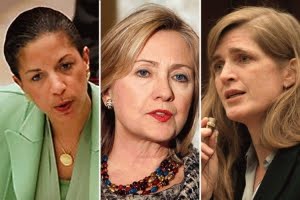
The Holy Trinity of the U.S. "humanitarian" bombing campaign: UN Ambassador Susan Rice (L), Secretary of State Hillary Clinton (center), and self-proclaimed "genocide chick" Samantha Power (R).  If only there were trading cards for the heavy hitters of the Responsibility to Protect (R2P) doctrine, we'd be on our way to owning the whole set.
Even by Rice's limited yardstick, however, the Western alliance has already disbursed a hefty US$1 billion on the war. By September 30, when the second NATO authorization for the war expires, the U.S. projects its own total Department of Defense (DoD) expenditures will have reached $1.1 billion (link).
 
[Since this is not officially a war, the Obama administration has insisted that it is under no obligation to report its costs to Congress.  The US wrote a letter to Congress describing its DoD accounting, and France and the UK have estimated the costs of their contributions at irregular intervals.  UK: EP 260 million as of June 24 (link); France Euros 160 million by July 13 (link).]
 
In any event, there is no obvious political constituency in Europe or the US for pouring foreign dollars into Benghazi. Sherman, for instance, proposed that the operation be funded by confiscating Gaddafi's frozen assets in the US[ms6] , reminiscent of US efforts to pay for the Iraq War with Iraqi oil revenues. The desire to make Gaddafi pay for the war against him by seizing his frozen assets is widespread. Nevertheless, a hitch remains: countries such as Canada have laws on their books that prevent them from unfreezing Libyan assets until the UN Security Council gives its OK - a virtual impossibility given Russian and Chinese opposition to the West's adventurism.13
 
In an uncanny reprise of the enthusiasm for financial derivatives that plunged the world into the Great Recession, the LCG is encouraging interested states such as Canada to evade the UN process by lending cash to the TNC, with the loans collateralized by frozen assets.
 
In a further sign that the US is not confident that the TNC can run its finances any better than it runs its war (and perhaps has achieved a belated awareness of the risks involve in lending ready cash against illiquid assets) it declared that most of the $30 billion in Gaddafi assets in the US were illiquid, i.e. real estate, hence a mere $3.5 billion could potentially be funneled to the TNC.14
 
Nevertheless, Western financial creativity, once again deployed in the absence of Western hard cash, will undoubtedly succeed in forestalling the collapse of the Benghazi authority for the foreseeable future.
 
The second purpose of the Istanbul meeting was to cut the legs out from under other negotiators - such as the Gaddafi-friendly African Union, which was holding talks with regime representatives in Ethiopia and, for that matter, the French, who were sowing epic confusion through equivocal secret contacts with Gaddafi's representatives - by setting up a single, publicly-endorsed channel.
 
Apparently, despite its new-found ascendancy as Libya's legitimate ruling authority, the Transitional National Council does not, in the opinion of the LCG, have the wherewithal to engage in direct negotiations with Gaddafi's rebel bastion in Tripoli.
 
But the TNC was not the only organization to receive the back of the hand treatment from the Libya Contact Group. The UN also got a slap.
 
Abdul Elah al-Khatib: the LCG's UN errand boy?
Initial reports indicated that the UN's special envoy for Libya, Abdul Elah al-Khatib, would be the sole designated interlocutor for the LCG. Franco Frattini, Italy's loquacious foreign minister, told reporters in Istanbul: “Mr Khatib is entitled to present a political package. This political package is a political offer including a ceasefire.”15 His remarks on Khatib’s "authorized" status were echoed by Frattini's British counterpart, William Hague. This raises the interesting question of how the LCG, an ad hoc organization with no legal standing, can order around the UN's Khatib as its errand boy.
 
The problem has apparently been rectified.  It seems that Ban Ki-moon, the ever-pliant UN secretary general, has agreed to put the LCG program into effect without the inconvenience and embarrassment of a UN Security Council discussion or vote, as Bloomberg reports:

UN Secretary-General Ban Ki-moon will be the only person authorized by the contact group to negotiate with both sides in Libya. Ban will set up a board of two to three interlocutors from Tripoli and the rebel-held town of Benghazi, Frattini said.16

United Nations Secretary General Ban Ki-Moon (C) stands between  Qatar's Crown Prince Sheikh Tamim bin Hamad al-Thani (L) and Qatar's Prime Minister and Minister of Foreign Affairs, Sheikh Hamad Bin Jissim Bin Jabr Al Thani, before the start of the first international contact group meeting on Libya in Doha April 13, 2011.

The Financial Times suggests that the passion to claim Gaddafi's scalp has evaporated in France and Italy and the Western powers will accept anything short of Gaddafi taunting them from his presidential throne in order to end the embarrassing conflict:

On Thursday it emerged that the western-led coalition confronting Colonel Muammer Gaddafi was beginning to examine the possibility of offering him a face-saving deal that removes him from power in Tripoli but allows him to stay inside Libya as a means of bringing a swift end to the conflict.
As some 40 nations prepare to meet in Istanbul on Friday to discuss progress in the NATO-led operation against the Libyan leader, Britain, France and the US continue to state publicly that the war can only end with Col Gaddafi's physical departure from Libya.
But behind the scenes in Paris and London, senior officials are discussing whether the international community and the Libyan opposition could offer a deal that sees Col Gaddafi surrendering all power while going into internal exile in Libya.
For several days, French officials have made clear that Col Gaddafi could stay in Libya if he makes a clear statement that he will abdicate all military and political power.17
In the best tradition of Western peacemaking, it appears that a Ramadan ceasefire will be preceded by a two-week barrage of bombs and missiles that will demonstrate both to the Gaddafi regime and world opinion that, despite its abject and obvious desperation to disengage, the NATO/GCC coalition is still a force to be reckoned with, even as it hastens to fulfill its publicly-stated ambition to be "out  of there" by September.
 
The most plausible roadmap for Libya's post-conflict (or perhaps more accurately, mid-conflict) future is Turkey's roadmap, which foresees a Ramadan ceasefire, Gaddafi leaving power but not the country, and a constitutional commission.
 
As floated in the Turkish media, "the core of the commission would consist of five people: Two from Tripoli who would be accepted to Benghazi, two from Benghazi who would be acceptable to Tripoli and a fifth who would be named by those four who would set up the basis for a new constitution in Libya."18
 
A prompt ceasefire and a negotiated settlement do not leave the TNC with a very attractive hand. It controls less than half the country (albeit the predominantly oily half). Furthermore, it is unlikely to perform outstandingly in any nationwide democratic contest that would involve canvassing for votes among the inhabitants of western Libya, a certain number of whom are likely to regard the TNC as venal and incompetent eastern adventurers who conspired with foreign powers to bomb and sanction the residents of Tripoli into misery and poverty.
 
Map of Gaddafi and rebel-held positions (July 7th) 
No wonder the TNC spokesperson, Mahmoud Shamam, harrumphed to journalists in Istanbul that the TNC would ignore a ceasefire saying, "Even the Prophet Mohammed fought during Ramadan. We will continue to fight for our lives."19
 
However, if the West's Libya fatigue holds and the war doesn't re-ignite, the TNC may find itself lording itself over Benghazi in a de facto partitioned Libya, using its advantageous location vis-a-vis Libya's oil reserves to sustain its economy and its diplomatic standing.
 
In an indication of world resignation to a divided Libya, even China and Russia, who regard the TNC as a travesty and calamity, have pledged money for "humanitarian assistance" to "the Libyan people".
 
TNC Executive Board Chairman Mahmoud Jibril visited Beijing in late June for a meeting that Beijing used to announce that it had decided to engage with the TNC as “a powerful opposition force” and highlight the PRC’s hopes for a mediated political solution to the Libyan conflict through the African Union mechanism (link).
 
Transitional National Council chair Mahmoud Jibril
The LCG’s decision to withdraw Gaddafi and anoint the TNC as Libya’s sovereign, even as momentum seemed to build for a negotiated settlement, was reflected in an unenthusiastic show of Chinese support for the TNC.
 
On the heels of a Russian announcement that it was sending 36 tons of aid to Benghazi, a terse announcement from China's Ministry of Foreign Affairs stated on July 11:

Q: The prolonged war in Libya deteriorates the humanitarian situation there. Will China consider providing humanitarian assistance to Libya?
A: In a bid to alleviate the humanitarian disaster faced by the Libyan people, China has decided to provide 50 million RMB [US$8 million] worth of humanitarian assistance to them.20
This may be symbolically important, but - considering that the TNC has consistently declared it needs $3 billion in cash to keep the doors open in Benghazi – the offer amounts to little.
 
On the other hand, China made its feelings about the LCG clear as it publicized a phone call by Hu Jintao to South African president Joseph Zuma endorsing the AU peace process.  The AU initiative appears to differ from the LCG/Turkish initiative in one crucial aspect: it recognizes the continued legitimacy and sovereignty of the regime in Tripoli.
 
As for the West, it can content itself with the observation that, if it wasn't able to save Libya, at least it was able to cripple it. It is a pattern that the West has repeated in its engineered partition instead of national reconciliation in Kosovo and Sudan, and in midwifing the fragmentation of the Soviet Union into a suspicious Russia and a host of new NATO members.
 
It is another lesson in US "nation-building" - born of a characteristic disregard for sovereignty, circumvention of the United Nations, a cavalier attitude toward international law and a reckless deployment of military power – to which China, one of the last remaining multinational empires, is likely to pay close attention.

Peter Lee writes on East and South Asian affairs and their intersection with US foreign policy.
This is a revised and expanded version of an article that appeared at Asia Times.
 
Recommended citation: Peter Lee, "The Labyrinthian International Geopolitics of the Libyan Conflict," The Asia-Pacific Journal Vol 9, Issue 31 No 2, August 1, 2011.
 
 
Notes
1 World leaders open Libya talks in Turkey, The Raw Story, Jul 15, 2011.
2 Zuma, Cameron Set to Clash, IOL News, Jul 16, 2011.
3 Libya Contact Group: Chair's statement, UK Foreign and Commonwealth Office, Apr 13, 2011.
4 Assessing the Situation in Libya, US Department of State, May 12, 2011.
5 NATO's Decision-Making Procedure, CRS Report for Congress, May 5, 2003.
6 Teleconference Background Briefing on North Atlantic Council (NAC) Discussions on Libya, US Department of State, Mar 24, 2011.
7 Russia not to attend Libya Contact Group meeting July 15, ITAR-TASS News Agency, Jul 13, 2011.
8 Russia denounces Libya contact group as 'illegitimate' , Telegraph, May 13, 2011.
9 Russia not to attend Libya Contact Group meeting July 15, ITAR-TASS News Agency, Jul 13, 2011.
10 NATO's Debacle in Libya, Counter Punch, Jul 15, 2011.
11 A Wilsonian move by the White House in Libya, Foreign Policy, Jul 15, 2011.
12 Democrat says Libya costs run much higher, Washington Times, Apr 7, 2011.
13 Canada mulls ways to fund Libyan rebels with frozen Gadhafi assets, Jul 16, 2011.
14 Summary of the American and International Press on the Libyan Revolution - Morgan Strong, Tripoli Post, Jul 17, 2011.
15 UN Envoy to Lead Libya Talks, Al Arabiya News, Jul 16, 2011.
16 Libyan Rebels Get U.S. Recognition Without Keys to Qaddafi's Frozen Cash, Bloomberg, Jul 15, 2011.
17 Click here for text.
18 Turkey seeks Libyan truce before Ramadan, Hurriyet Daily News, Jul 14, 2011.
19 Libyan TNC vows to continue military action in Ramadan, People's Daily, Jul 16, 2011.
20 Foreign Ministry Spokesperson Hong Lei's Remarks on China Providing Humanitarian Assistance to Libya, Chinese Foreign Ministry, Jul 11, 2011.